Why does my partner feel like a stranger?
By Ferhat Açıkalın · · 8 min read · Connection & intimacy
Grounded in the Gottman Method, the same approach your guide works from.

On this page
Your partner can feel like a stranger for two quite different reasons. If it has crept up over months, it's usually drift: you've stopped updating what you know about each other's inner world, so the person in front of you has changed without you seeing it. If it hits suddenly, in a strange place or a quiet moment, it's often just your brain seeing a familiar face out of its usual context for a second, which is common and usually passes. Drift is reversible with curiosity and small daily moments of contact; the sudden flash usually needs nothing at all.
Emotional closeness isn't a permanent state. It needs regular, small moments of connection to stay alive, and when life gets busy those moments dry up.
You're not alone in feeling this way
Most couples hit this wall at least once. You're sitting across the dinner table, or lying next to each other in bed, and something feels… off. Not dramatic. Not a big fight. Just a low hum of unfamiliarity. Like you're sharing a home with someone you used to know really well.
It can be alarming, especially if the relationship looked fine from the outside. But feeling disconnected from your partner doesn't mean the relationship is broken. It usually means it's been running on autopilot for a while.
The sudden "who is this person?" moment
Some people describe it very specifically: you're travelling, somewhere unfamiliar with just your partner, or you glance across a room, and for a moment they look like someone you don't know. It can be unsettling, but a brief flash like this is common. Familiarity is partly about context, and when the usual background of home and routine is stripped away, you see the person a little more like a stranger would. Many people find the feeling passes within minutes, and some even find it brings back a flicker of how they saw their partner at the start.
If these moments come often, last a long time, or you feel detached from everything and everyone, not just your partner, as if the world were unreal, mention it to your doctor. That can be linked to anxiety, exhaustion or depersonalisation, and it is treatable.
What actually causes that "stranger" feeling
There's rarely one single reason. It's usually a quiet build-up of small things over time. Here are the most common culprits:
- Life transitions. A new job, a baby, moving house, a bereavement, any big change pulls your attention inward and leaves less room for each other. You adapt to the new life, but you adapt separately. It's especially common when children leave home and it's suddenly just the two of you again (see coping with empty nest syndrome as a couple).
- Unspoken resentments. Small frustrations that never got aired don't disappear. They pile up as a kind of invisible wall. You're not fully present with each other because part of you is still quietly nursing an old hurt.
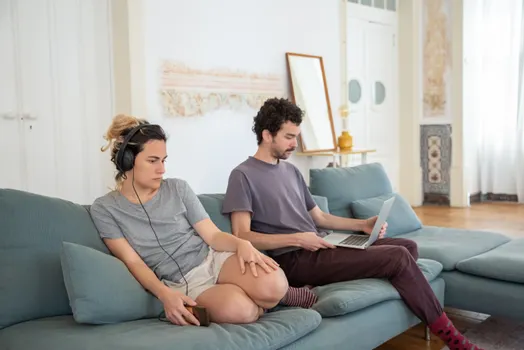
- Screens and schedules. It sounds mundane, but hours lost to phones, different sleep times, and packed diaries genuinely erode the casual togetherness that keeps closeness alive.
- Avoiding hard conversations. If there are topics you both quietly agreed never to bring up, those subjects take up emotional space. Avoidance creates distance.
- Growing and changing. People evolve. Interests shift. Values deepen or change direction. That's healthy, but if you haven't been sharing those changes as they happen, you can end up with a partner you don't fully recognise anymore.
What the research says (in plain English)
Relationship researcher John Gottman spent decades studying what keeps couples close. One of his most practical ideas is the concept of "turning toward", the small, everyday moments when one partner makes a bid for connection (a comment, a question, a touch) and the other responds.
When we consistently miss those bids, not out of cruelty, just distraction or busyness, the emotional bank account empties slowly. You don't notice the individual withdrawals. You just wake up one day feeling like strangers.
Gottman also describes "love maps": the detailed picture you carry of your partner's worries, hopes and daily life. Love maps go out of date quietly. When yours is years old, the real person no longer matches it, and that mismatch is exactly what feels like strangeness.
The hopeful flip side: turning toward each other in small ways, consistently, is also how you refill that account. You don't need a weekend retreat. You need Tuesday evening. For a step-by-step version, see how to regain emotional connection.
Is this distance, or something more serious?
It's worth being honest with yourself here. Simple drift, the kind described above, feels like numbness or unfamiliarity. It often comes with a quiet sadness, but not necessarily anger or contempt.
If what you're experiencing feels more like walking on eggshells, persistent coldness, or contempt (eye-rolling, sarcasm, dismissiveness), that's worth taking more seriously with the support of a couples therapist. Coupleship can help you build daily connection habits, but it's not a substitute for professional help when things run deep.
And if you or your partner are experiencing any form of emotional or physical abuse, please reach out to a qualified professional or a helpline in your area. No app is equipped for that, you deserve real, human support.
Small things that actually help
You don't need to have The Big Conversation right away. In fact, starting smaller often works better. Here's what tends to move the needle:
- Get curious again. Ask a question you genuinely don't know the answer to. Not "how was your day?", something more specific, like "what's been quietly bothering you lately?" or "is there anything you've been thinking about that you haven't told me?" Curiosity is the first step back toward closeness.
- Name the distance without blame. Instead of "you've been so distant," try "I've been feeling a bit disconnected from you lately and I miss you." That's an invitation, not an accusation.
- Create one small ritual. A five-minute catch-up with phones face-down. A morning coffee together. A brief check-in before sleep. Rituals give closeness a container, they make it happen even when life is chaotic.
- Share something new about yourself. Tell them about something you've been thinking about, a fear, a small dream, an opinion you've changed. Vulnerability reopens the door to knowing each other.
- Acknowledge the good stuff. Actively noticing and saying out loud what you appreciate about your partner rewires both of you toward warmth. It sounds simple. It works.
What not to do
A few things tend to make the stranger feeling worse, even when the intention is good:
- Waiting for the "right moment" to talk, it rarely arrives on its own.
- Keeping score of who's been more distant or who should make the first move.
- Treating one big gesture (a holiday, a fancy date) as a fix when daily habits are the real issue.
- Assuming your partner knows how you feel without you saying it.
If the stranger feeling comes with a deep loneliness even when you're side by side, how to stop feeling lonely in a relationship may help, and feeling disconnected from your partner covers the wider picture.
Common questions
Is it normal to feel like your partner is a stranger after years together?
Yes, completely normal, and very common. Long-term relationships go through phases of closeness and distance. Feeling this way doesn't mean you chose the wrong person; it usually means you've both been pouring energy into other things. Awareness of the drift is already the first step toward reversing it.
Can you fall back in love with someone who feels like a stranger?
Most of the time, yes. What you're usually rediscovering isn't a new person, it's a deeper, more current version of the one you already love. Some couples who make space for curiosity and honest conversation say they end up feeling closer than they did early on, because they now know each other as they are.
How long does it take to feel connected again?
There's no fixed timeline, but many couples notice a shift within a few weeks of consistent small effort, not grand gestures, just regular, genuine attention. If things don't improve after sustained effort, or if the distance feels entrenched, talking to a couples therapist is a wise and caring next step.
When you are ready to try this with some support, Coupleship gives the two of you one shared room with a Gottman-based guide, plus a private line that stays just yours. You can start alone, free and without a card.
Filed under emotional distance · reconnecting · relationship drift · communication · intimacy · gottman