What does Gottman mean by turning towards your partner?
By the Coupleship team · · 8 min read · Gottman method concepts
Grounded in the Gottman Method, the same approach your guide works from.

On this page
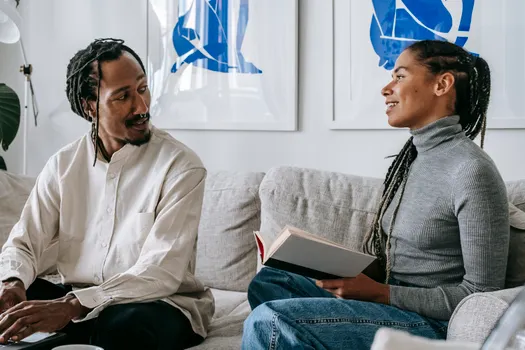
Turning towards your partner means responding to their bid for connection instead of letting it pass. A bid is any small reach for your attention, humour, or support, like "you have to see this" from the other room, and turning towards is simply answering it. It takes seconds, not a whole evening.
Gottman's research calls this the everyday choice that builds trust. You are not fixing anything or solving a problem. You are showing your partner that when they reach, you are there.
So, what does turning towards your partner actually mean?
Think of it as the response side of connection. Your partner reaches out, and you either turn towards them, turn away, or turn against them.
- Turning towards: you acknowledge the reach, even briefly.
- Turning away: you ignore it, stay absorbed in your phone, or say "mm-hmm" without looking up.
- Turning against: you meet the reach with irritation, like "can't you see I'm busy?"
Turning away is not cruelty. Most of us do it without noticing. But done often enough, it teaches your partner that reaching for you is not worth the effort, so they stop. That quiet stop is where distance begins, which is the same thread we wrote about in roommate phase or drifting apart.
If you are still deciding whether a reach is an invitation or an opening for conversation, our piece on bids for connection walks through the noticing side. This article is about what happens after.
What a bid sounds like in a real kitchen
Bids are rarely grand. They sound like this:
- "Did you see the sky just now? It's so pink."
- Reading a headline aloud from the sofa.
- Holding up a weirdly shaped carrot.
- "This soup is really good, try some."
- A quick look across the table when someone at the next table says something ridiculous.
- "Long day. I don't even know where to start."
Notice that most of them do not ask for a favour. They ask for a small moment of shared attention. The truth is that a bid can also arrive dressed in frustration, like "you never watch anything I pick." That is not mostly an attack on your taste in TV. It is usually a reach for connection that came out sideways. The way to tell them apart is in the eyes. A bid still wants you to come closer. Real criticism has already given up on that, and it tends to be more global, more "always" and "never."
If you're not sure which one you're hearing, our article on criticism vs complaint gives you the one line that separates them.
What to say when you notice a bid
Turning towards does not require a long answer. It requires a real one. Here are some phrases you can steal:
- Stop and look. Set down what you're holding, even for five seconds, and make eye contact. "Wait, tell me that again."
- Acknowledge without fixing. "That sounds like a rough meeting, I'm sorry." You do not need to suggest a solution yet.
- Ask one small follow-up. "What was the worst part?" Small follow-ups are the whole game.
- If you can't stop right now, name it. "I want to hear this, give me ten minutes to finish this email and then I'm yours." Then actually go back.
- Match their energy when they're playful. If they hold up the carrot, hold up a spoon and make a silly face. Play is a bid too.
- Say yes to the tiny thing. "Come see this" met with "one sec" and a walk to the window counts as turning towards.
None of these take more than two minutes. Most take ten seconds. That is the part people miss. Turning towards is less about big romantic gestures and more about being interruptible.
When you realise you already turned away
Everyone misses. The skill is not perfect attendance, it is repair. If you catch yourself a minute later, you can still turn towards what already happened.
"I brushed you off before and I'm sorry. Tell me what you were saying. I want to hear it."
You can say that after a sigh, a glance away, or a half-hearted "yeah, sounds good." The repair is not about apologising for being busy. It is about the fact that it mattered and you want it back. Partners rarely need you to have caught it the first time. They need to see that you notice when you did not.
This also works after a fight. If you're still angry, you can say "I'm still upset about earlier, and I don't want to pretend I'm not. But I'm here." That is honest turning towards, and if you're looking for words for the fight itself, our piece on repair attempts picks up from there.
What if your partner stopped bidding?
This is the hardest version, and it is often why people search this. When someone has turned away a lot, they gradually stop reaching. It can look like a partner who is always on their phone, a partner who has gone quiet, or a partner who answers every question with one word.
Before you assume the worst, try a low-stakes re-entry. Not "why don't you ever talk to me?" That is a bid for connection disguised as a complaint, and it usually gets a defensive answer. Try instead:
- "I've been in my own head lately and I miss you. Want to sit outside for ten minutes?"
- "I noticed I've been getting to the couch and straight to my phone. Let's put both away tonight and just talk."
- "I picked a show for us both, no pressure if it's not your thing."
If they're chronically distracted, make a household rule instead of a complaint. "Phones in the basket on the kitchen counter from dinner until the kids are down." A rule turns a vague request into something you do together. For that specific dynamic, our article on partners turning to a screen instead of you goes deeper.
And if your partner is struggling with depression, addiction, or something bigger, the problem is bigger than missed bids. Coupleship is not a substitute for professional therapy. A licensed couples therapist can help when reaching out is met with a wall.
How many missed bids is normal?
There is no magic number, but there is a useful scale. Gottman's questionnaires ask people to read 20 statements and mark each one true or false. Statements like "I can tell when my partner needs a hug" and "my partner is interested in what I have to say." A score of 12 or more trues suggests this is going reasonably well. Fewer than that is a signal, not a verdict.
You can do that exercise tonight, in five minutes, straight from the sofa. Read the statements out loud and each hold up a finger for true. You'll learn something in the gaps.
As a simple warm-up, try this for one week. Each night, name one specific moment your partner turned towards you, and thank them for it. "You put your book down when I started talking about my mum. Thank you." Specific is the key. "Thanks for being supportive" slides right off, but "you looked up when I walked in" lands.
So no, turning towards is not about saying yes to everything your partner asks. It's about the direction you lean when they reach. Small, often, and repairable.
Common questions
Is turning towards the same as always saying yes to my partner?
No. Turning towards means acknowledging the bid, not agreeing to the request. You can say "I can't watch the whole thing right now, but I'm interested, give me two minutes" and still be turning towards. Turning away is when you ignore them or wave them off. The difference is whether they feel seen, not whether they got their way.
What if my partner is always on their phone when I try to connect?
First, say it once, directly, without sarcasm. Then make a shared rule rather than a one-off complaint: phones in a basket on the kitchen counter from dinner until the kids are down, or no screens on the sofa after eight. Rules work better than requests because neither of you has to police the other. Then rebuild from small, low-pressure moments, not one big summit.
Can I turn towards my partner if I'm still angry from an earlier fight?
Yes, and it can be part of repairing the fight. Be honest about where you are: "I'm still upset about earlier, and I don't want to pretend I'm not. But I'm here." You are not sweeping the fight under the rug. You are showing that the connection matters even while the disagreement is open.
Turning towards is a skill you build in tiny moments, and it gets easier with practice. Coupleship is built to help you practice. You can start on your own with a private guide grounded in the Gottman method, invite your partner when you're both ready, and it's free to start with no card needed.
References
- What are the Marital Problems of Happy Couples? A Multimethod, Two‐Sample Investigation (opens in a new tab) · Amy Rauer, Allen K. Sabey, Christine M. Proulx et al. (2019)
- PERCEIVED RELATIONAL FACTORS IN MARITAL (IN)STABILITY AMONG MARRIED AND DIVORCED BOSNIANS: DO WE UNDERSTAND EACH OTHER? (opens in a new tab) · Selvira Draganović (2022)
Filed under Gottman method · turning towards · bids for connection · emotional connection · everyday moments